Finding a customer quickly is essential when you need to view customer details, manage orders, update lists, or send targeted communications. AiTrillion makes it easy to locate customers using search, filters, and customer lists. This article explains the different ways to find a customer in your account so you can efficiently access the right customer information and take action without any hassle.
How To Find A Customer?
Introduction:
Here are the steps to find a customer:
Step 2: Click on the Create segment button >> and click on the Add Filter button.
You can search in many ways, the available filters are:
Available filters:
Customer Filters
Email – Filter customers by their email address.
Store customer ID – Filter using the unique customer ID from the store.
First name – Find customers by their first name.
Last name – Find customers by their last name.
Customer status – Filter customers based on their current status (active or inactive).
Customer tag – Segment customers using assigned tags.
Last seen – Customers who were last active on the store.
First seen – Customers who visited the store for the first time.
Customer type – Segment customers based on type which is received from Shopify.
Phone – Filter customers using phone numbers.
Sign up date – Customers who signed up during a specific period.
Account status – Filter based on account state (Active/inactive).
Company name – Filter B2B customers by company name.
Verified email – Customers with verified email addresses.
Note – Filter customers based on notes added to their profile.
Loyalty blocked – Customers blocked from loyalty rewards.
Customer birthday – Customers with birthdays on specific dates.
Email Filters
Number of clicked campaign – Customers who clicked email campaigns.
Last campaign sent date – Date when the last email campaign was sent.
Last campaign opened date – Date when the last campaign was opened.
Last campaign clicked date – Date of the last campaign click.
Number of delivered campaign – Total number of emails delivered.
Last email open type – Type of open (human or machine).
Last email open – Date/time of last email open.
Last email link click – Date/time of last email link click.
Email bounced – Customers whose emails bounced or not.
Marketing email subscription – Marketing email subscription status of AiTrillion.
Workflow email subscription – Workflow email subscription status of AiTrillion.
Email campaign – Filter based on campaign participation.
Number of sent campaign – Total campaigns sent to the customer.
Email complaint – Customers who marked emails as spam.
Number of opened campaign – Total campaigns opened.
Shop Filters
Shop name – Filter customers by store name.
Domain – Filter by store domain.
Address Filters
Street 1 / Street 2 – Customer street address.
City – Customer city.
Province – State or province.
Country – Customer country.
Zip – Postal or ZIP code.
Province code – State/province code.
Country code – Country code.
Affiliate Filters
Affiliate group – Customers linked to an affiliate group.
Smart Popup Filters
Smart popup – Customers who interacted with a popup.
Smart popup submission date – Date of popup form submission.
SMS Filters
Number of delivered SMS campaign – SMS campaigns successfully delivered.
Accept SMS marketing – Customers who opted into SMS marketing.
Marketing SMS subscription – SMS subscription status.
SMS bounced – Failed SMS deliveries.
Visited product handle – Customers who visited a specific product.
Number of SMS sent campaign – Total SMS campaigns sent.
Last SMS campaign sent date – Date of last SMS campaign.
Loyalty Filters
Points expire – Customers with expiring loyalty points.
Loyalty point – Total loyalty points earned.
Points remaining – Available loyalty points balance.
Points redeemed – Points already redeemed.
VIP tier – Customer VIP tier.
Loyalty refer status – Referral participation status.
Push Filters
Push access – Customers who enabled push notifications.
Review Filters
Review – Customers who left product reviews.
Review email subscription – Subscription status for review emails.
Tracking Filters
Accepts marketing – Customer marketing consent status of Shopify.
Unique visit count – Number of unique store visits.
WhatsApp chat widget click – Clicks on WhatsApp chat widget.
Last engaged date – Last interaction date.
Created source – Source where the customer was created.
Contact source – Source of customer contact.
Source detail – Detailed acquisition source.
Visited product – Products visited by the customer.
Last engaged by – Channel used for last engagement.
Order Filters
Last order name – Name of the last order.
Last order ID – Order ID of the most recent purchase.
Average order amount – Average spend per order.
Total spent – Total amount spent by the customer.
Order date – Date when order was placed.
Order count – Total number of orders.
Last order date – Date of most recent order.
First order date – Date of first purchase.
Order price – Value of a specific order.
Product title – Purchased product name.
Vendor – Product vendor or brand.
Product attribute set – Product attributes used.
SKU – Product SKU.
Product tag – Product tags.
Order tag – Order-level tags.
Order status – Current order status.
Order note – Notes added to the order.
Membership Filters
Membership created date – Date when membership started.
Membership plan member – Customers in a specific plan.
Total active membership – Number of active memberships.
Total inactive membership – Number of inactive memberships.
Is member – Whether the customer is a member or not.

Note: If you are using 2 filters together, you can use an AND or an OR condition:
1.) That match all filters - AND condition
2,) That match any filters - OR condition
First name filter
Step 4: Filter the customers according to your requirement. For example, I am using the first name filter.
Step 5: Select an option by which you want to filter the customers. For example, I am using Contains.
Step 6: Fill in the value in the text field and click on Done.
Step 7: Click on the Apply filter button.
The results will be shown below in the list.
You can reset the filters by clicking on the Clear All button.
You can follow the same process with other filters as well.
 Note: If you want to filter the customers using an email address, then you need to search with the exact value.
Email address filter
Step 1: Filter using the email address. Click on Email.
Step 2: Choose the required option.
Note: If you are adding the email, you need to fill in the exact value.
Step 3: Click on the Apply Filter button.
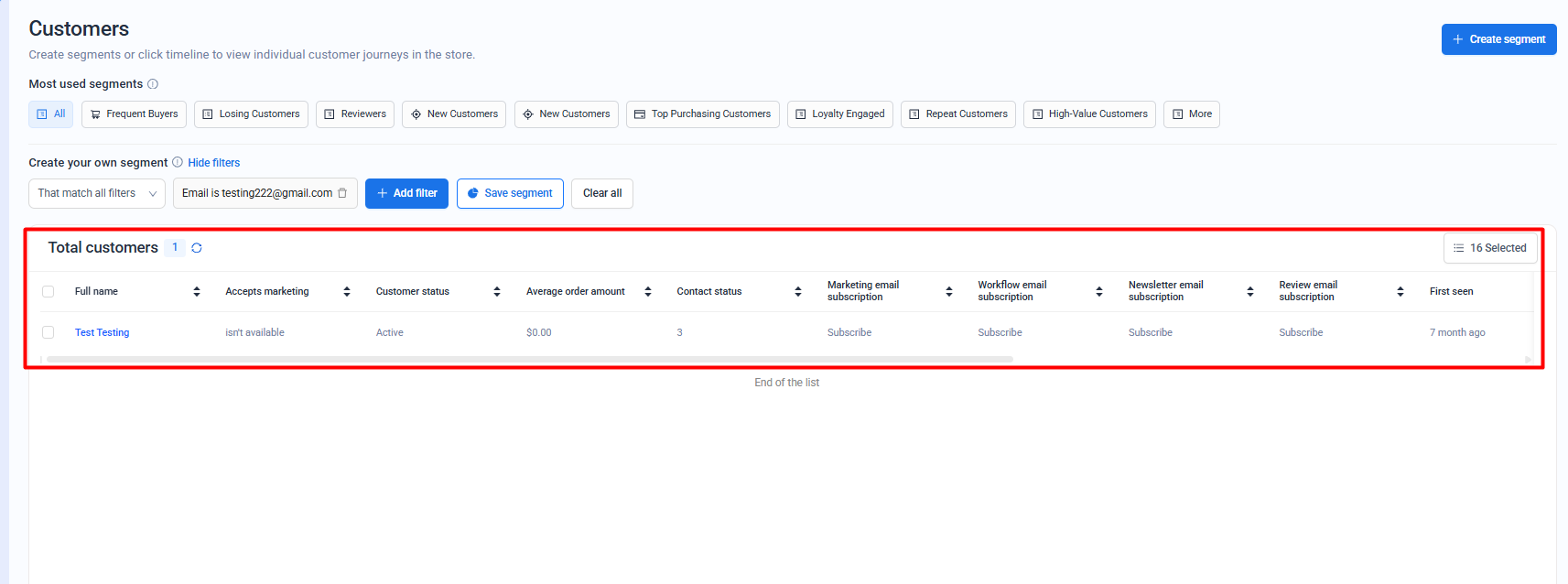
Now, the results will be shown in the list below:
Important Notes:
You can find customers using search, filters, or customer lists, depending on the information you have.
Searching by email address is the fastest and most accurate way to locate a customer.
Filters can be combined to narrow down results and quickly find the right customer.
The available filters cover multiple categories such as Customer, Email, Order, Loyalty, SMS, Tracking, and Membership.
Make sure to click Apply / Search after selecting filters to display the filtered results.
Using too many filters at once may return no results, so apply filters gradually.
Saved filters in a segment can be reused to speed up future searches.
Customer lists are helpful when you want to find a predefined group of customers.
If a customer is not visible, verify that the contact status allows the customer to appear in results.
Data shown in filters depends on customer activity and store data availability.
Recently created or updated customers may take a short time to reflect in filter results.
Always clear filters before starting a new search to avoid incorrect results.
Finding customers accurately helps with segmentation, targeting, and campaign management.